Clipping vs influencer marketing: which gets more views per rupee?
It depends on how far one Reel travels. An influencer takes a flat fee per Reel, agreed before it posts, so the views are a gamble. Clipping pays many creators a rate per 1,000 verified views up to a budget you cap, so you pay only for views that actually happen.
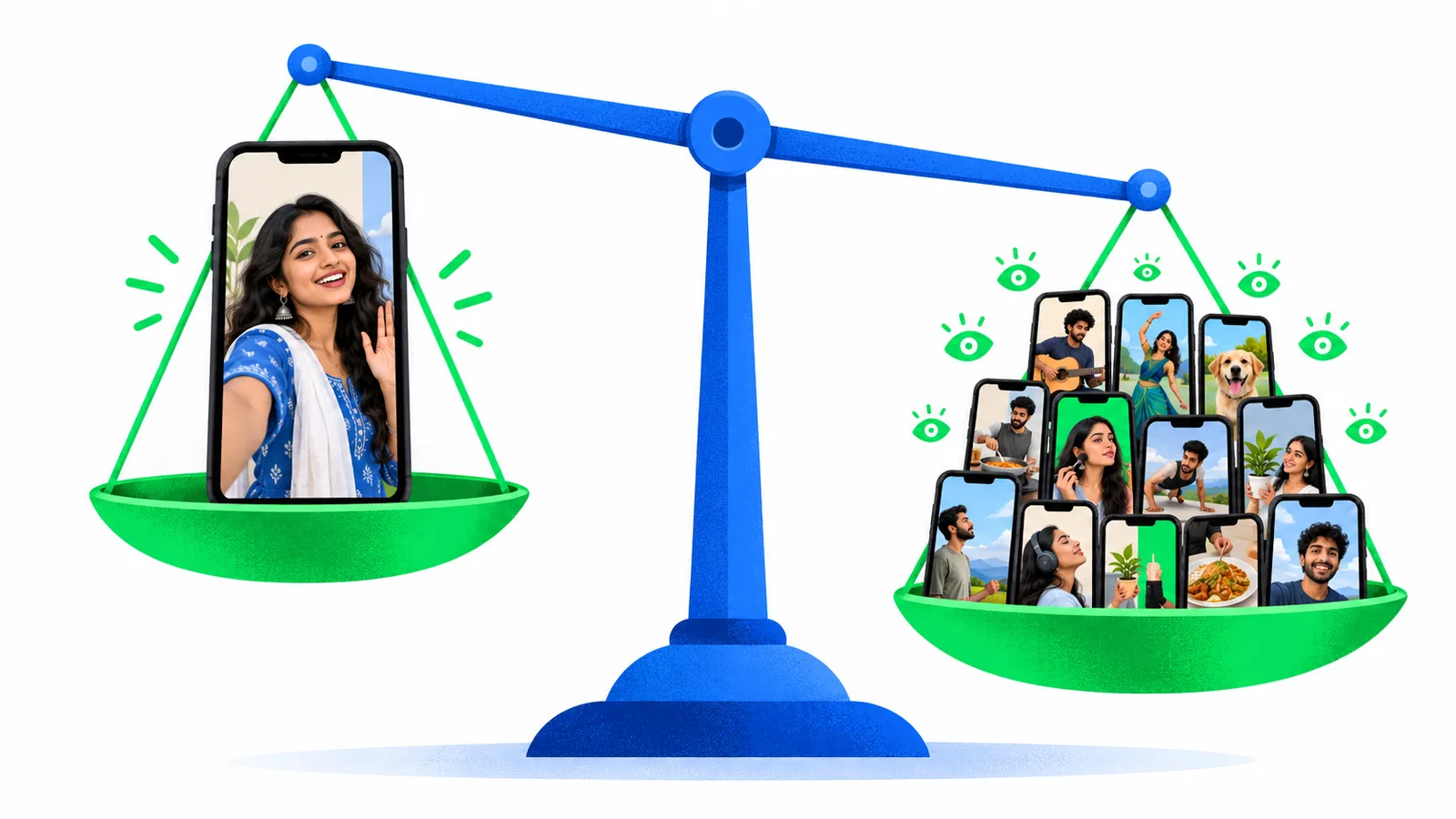
What is the difference between clipping and influencer marketing?
Influencer marketing pays a chosen creator a fixed fee to post about your brand to their own followers. Clipping pays many creators a rate per 1,000 verified views to post short clips of your brand, cut from your footage, on their own accounts. The first buys a post and an audience. The second buys views, counted after they happen.
Both end with a vertical video on a creator's Instagram Reels or YouTube Shorts. The difference is what the money is tied to. An influencer fee is tied to the creator: their follower count, their niche, their reputation. A clipping payout is tied to the clip: how many people actually watched it.
This post is published by Musubi, an Indian marketplace where brands fund campaigns that pay creators per 1,000 verified views. We sell clipping, so read the comparison with that in mind. Every rate below that is not ours comes from a dated, linked source, and the worked example shows its arithmetic so you can rerun it with your own numbers.
How is influencer marketing priced in India?
Influencer marketing in India is priced as a flat fee per deliverable, set mostly by follower tier. You agree the fee before the post exists, and it does not change with the views the post gets. A Reel that flops costs the same as a Reel that travels.
upGrowth's influencer pricing guide for India, updated 16 September 2026, gives these ranges per deliverable, marked as its own estimates and "negotiation benchmarks, not fixed prices":
| Tier | Followers | Fee per deliverable (upGrowth, Sept 2026) |
|---|---|---|
| Nano | 1K to 10K | ₹2,000 to ₹8,000 |
| Micro | 10K to 100K | ₹8,000 to ₹80,000 |
| Mid tier | 100K to 500K | ₹50,000 to ₹3.5 lakh |
| Macro | 500K to 2M | ₹2 lakh to ₹12 lakh |
| Mega and celebrity | 2M and above | ₹8 lakh to ₹1 crore or more per campaign |
Three things move the price beyond the tier, all from the same guide:
- Bundles. A Reel, Story and feed post combo costs 1.6 to 2 times a single Reel.
- Usage rights. Letting the brand repost the video adds 25 to 40 percent. Whitelisting, where the brand runs ads through the creator's handle, adds 60 to 120 percent. Perpetual usage adds 80 to 150 percent.
- Exclusivity. Thirty days of category exclusivity adds 30 to 50 percent to the base rate.
Payment usually starts before the post. Superprofile's rate card guide for Indian creators, updated 15 October 2026, gives a sample term of "50% advance, 50% within 15 days of posting; GST extra if applicable". That is a sample creators are told to adapt, not a law, but it shows the norm a brand meets: half the money is committed before anyone has watched anything.
How is clipping priced?
Clipping is priced per 1,000 verified views. The brand funds a budget, sets the rate per 1,000 views and a cap per clip, and creators earn the rate on the views their clips get, up to the cap, until the budget runs out. Nothing is paid on a clip until its views are counted and the clip is reviewed.
On Musubi the terms work like this:
- The budget is a hard ceiling. The minimum is ₹2,000. Earnings accrue against the budget and never past it.
- The brand sets the rate. The lowest rate accepted is ₹30 per 1,000 verified views.
- The brand sets a per clip cap. It is the most one clip can earn. A cap above half the budget is refused, because two creators is not a campaign.
- A 10 percent platform fee sits on top of the budget, shown before you fund. It is taken at launch and not refunded after launch, even if the campaign is paused.
- Unspent budget comes back to your Musubi wallet when the campaign closes.
- Creators post on their own accounts, on Instagram Reels or YouTube Shorts. There is no follower minimum, because payment follows views delivered. Views are read from the post on a schedule, and every clip is reviewed before it is paid.
Musubi runs two campaign types, both paid per 1,000 verified views. A clipping campaign has creators cut your existing content, such as a podcast, a founder talk or a product demo. A UGC campaign has creators make original content about your product. The UGC vs clipping guide explains the difference from the creator's side.
The ceiling arithmetic is simple. The most views a budget can pay for is the budget divided by the rate, times 1,000. The most you can be charged is the budget plus 10 percent. You see both before you pay, and the campaign calculator works them out for your numbers.
Clipping vs influencer marketing: a side by side comparison
Clipping and influencer marketing differ on almost every line except the format. The table compares them on the points a brand decides on.
| Influencer marketing | Clipping | |
|---|---|---|
| Who posts | One creator you choose, or a handful | Many creators who pick up your brief |
| Whose audience | The creator's followers, plus whoever the platform shows it to | Whoever the platform shows each clip to; follower count matters less |
| How pay works | Flat fee per deliverable, by follower tier | Rate per 1,000 verified views, up to a per clip cap |
| When you pay | Agreed before posting, often half in advance | After views are counted and the clip is reviewed |
| Risk | Brand carries it: a weak post costs the full fee | Shared: a weak clip earns little and costs little |
| What you get | One crafted post, the creator's endorsement and their audience's trust | Many clips, many hooks tested, views bought by the thousand |
| Control over message | High: you can agree a script and approve the draft | Set by the brief and your footage; clips that miss the brief are rejected, not paid |
| Disclosure | Required under ASCI for any paid post | Also required under ASCI; a paid clip is an ad |
The table hides one asymmetry worth naming. With an influencer, the uncertainty is in the outcome: you know the price, not the views. With clipping, the uncertainty is in the spend: you know the price per view and the ceiling, not how much of the budget creators will earn.
Which gets more views per rupee?
Neither wins every time. Clipping fixes your cost per 1,000 views at the rate you set, because it pays only for views that happen, while a single influencer Reel that travels far can beat it and one that flops costs far more per view. The answer for your brand comes from one number: how many views would the influencer Reel need to match the clipping rate? That break even is the fee divided by the rate, times 1,000.
A worked example at the same spend
For example, say you have ₹22,000 to spend. This is an illustration with picked numbers, not a forecast and not a typical Musubi rate. Tax is left out of both sides.
- Influencer option. One micro creator at ₹22,000 for a Reel. That sits inside upGrowth's ₹8,000 to ₹80,000 micro range.
- Clipping option. A ₹20,000 budget plus the ₹2,000 platform fee, so ₹22,000 is the most you can be charged. At an example rate of ₹40 per 1,000 verified views, the budget pays for at most 20,000 ÷ 40 × 1,000 = 5,00,000 views.
The influencer's cost per 1,000 views depends entirely on how the Reel performs:
| If the influencer Reel gets | Cost per 1,000 views (₹22,000 ÷ views × 1,000) |
|---|---|
| 25,000 views | ₹880 |
| 50,000 views | ₹440 |
| 1,00,000 views | ₹220 |
| 2,50,000 views | ₹88 |
| 5,00,000 views | ₹44 |
The clipping campaign's all in cost depends on how much of the budget creators earn, because the fee is charged on the whole budget:
| If clips earn | Verified views paid for | All in cost | All in cost per 1,000 views |
|---|---|---|---|
| The full ₹20,000 | 5,00,000 | ₹22,000 | ₹44 |
| ₹10,000 | 2,50,000 | ₹12,000, with ₹10,000 back in your wallet | ₹48 |
| ₹4,000 | 1,00,000 | ₹6,000, with ₹16,000 back in your wallet | ₹60 |
In this example the influencer Reel needs 5,00,000 views to match a fully spent clipping budget. Below that it costs more per view, and at 50,000 views it costs ten times more. The clipping side never costs more than ₹22,000, and a weak campaign costs less in rupees, though more per view, because the fee was set on the full budget.
Two cautions keep this honest. First, views past a clip's cap are not paid, so they come free; the cap limits spend, not reach. Second, the comparison counts views only. An influencer Reel carries something a clip from a stranger does not: a recommendation from a person the audience already follows. upGrowth puts micro creator engagement at 3 to 7 percent on Instagram. Whether that trust is worth the gap in cost per view depends on what you are selling.
Run your own numbers: take a quoted fee, divide by the rate you would set, multiply by 1,000, and ask whether that creator's Reels usually reach that many views. The cost per 1,000 views guide compares clipping rates with Reels and Shorts ad rates if you want a third column, and our guide to clipping vs Instagram and YouTube ads works that comparison through with an example.
What are the ASCI disclosure rules for influencers and clippers?
The same ASCI rules cover both. ASCI's Guidelines for Influencer Advertising in Digital Media, in the version carrying its 17 August 2023 addendum, say every ad an influencer publishes on their own account "must carry a disclosure label that clearly identifies it as an advertisement". A creator paid per view to post your clip has a material connection with your brand, so the clip is an ad and needs a label, just like a sponsored Reel.
What the guidelines require, in short:
- Disclose whenever there is a material connection. Money is not the only trigger. Free products, discounts, gifts and trips count too, and disclosure is needed even if the creator's opinion is unbiased.
- Use an approved label. ASCI lists Advertisement, Ad, Sponsored, Collaboration, Partnership, Employee, Free gift, Affiliate, Instagram's "Paid Partnership" tag and YouTube's "Includes Paid Promotion" tag. The label can be in English or in the language of the ad.
- Put it upfront. A label only in the bio, at the end of the video, behind the "more" cut of a caption, or buried among hashtags is likely to be missed. ASCI asks for a platform's disclosure tool to be used in addition to the creator's own label.
- Put it on the video when there is no text. For a video up to 15 seconds, a superimposed label stays at least 3 seconds. For 15 seconds to 2 minutes, it stays for a third of the video.
- Health and finance need credentials. Since the 2023 addendum, creators giving advice on banking, financial services, insurance, health or nutrition must hold the relevant qualification and state it upfront.
The brand is responsible too. The guidelines place responsibility for disclosure and for the content of the ad on both the advertiser and the influencer, and the advertiser must, where needed, ask the creator to delete or edit a post that breaks the code. So write the disclosure rule into your brief and check for it before you approve a clip or a Reel.
When should a brand choose influencer marketing, and when clipping?
Choose influencer marketing when you need a trusted voice; choose clipping when you need reach you can count and a cost you can cap. Most brands get the best result by running both, each for the job it does well.
Influencer marketing fits when:
- The product needs explaining or a demonstration, and a creator's personal use carries weight, as with skincare, finance apps or gadgets.
- You want one specific audience a creator has built, such as a city, a language or a hobby.
- You need the creator's own credibility, which no stranger's clip can supply.
Clipping fits when:
- You already have long footage, such as a podcast, a founder talking or product demos, and want it seen in short form.
- You want to know your cost per 1,000 views before you spend, with a hard ceiling.
- You want many hooks tested at once and to learn which angle travels.
- You have a small budget. On Musubi you can start a campaign at ₹2,000 and treat the first one as a test of whether creators pick your brief up.
Combining them works in two common ways. Run a clipping campaign first, see which hooks and angles pull views, then brief your influencers with what you learned. Or hire an influencer for a long video or a podcast appearance and fund a clipping campaign to cut that footage into many short clips, which stretches one fee across many posts. Check that your influencer contract lets you reuse their video before you hand it to clippers, since usage rights are priced separately.
If you are new to clipping, the step by step guide to running a clipping campaign in India covers the brief, the rate, the cap and the review. To choose where to run it, see our comparison of clipping platforms for brands.
 One trusted voice or many clips: the choice is about what your money is tied to.
Which mistakes waste money in clipping and influencer marketing?
The costliest mistakes come from treating either model as the other. An influencer fee bought for reach, or a clipping budget expected to build trust, both disappoint.
- Paying by follower count alone. Followers are not views. Before agreeing a fee, ask for the views on the creator's last ten Reels and work out the break even with the formula above.
- Ignoring usage rights. A fee usually covers one organic post. Reposting, running ads through the creator's handle or using the video forever costs extra, so agree it in writing before you plan a clipping campaign around their footage.
- Setting a clipping budget far above what creators will earn. The fee is charged on the whole budget, so a campaign that spends a small part of a large budget has a high real cost per view. Size the first one to what you expect to clear.
- A per clip cap too high. One clip can eat the budget. Musubi refuses a cap above half the budget; a lower cap spreads the money across more creators and more hooks.
- A vague brief. Clippers decide fast. Say what must appear, what must never be said and the disclosure label you expect, so you are not rejecting clips you could have prevented.
- Leaving disclosure to the creator. ASCI holds the brand responsible too. Put the label rule in the brief or contract and check it before payment.
- Judging clipping on one campaign. A first campaign tells you whether creators want your brief. It does not tell you what clipping can sell. Change the hook, the footage or the rate and run another.
Can you try clipping without dropping influencers?
Yes. A clipping campaign can run alongside your influencer plan, and a small one is the cheapest way to compare. Fund a test, set your own rate and cap, and see the most views you can pay for before you spend a rupee on the Musubi brands page. If you would rather talk it through first, contact the team.
Questions brands ask
Is clipping cheaper than influencer marketing?
Per view, clipping is usually cheaper, because it pays only for verified views up to a budget you set, while an influencer fee is fixed before the post exists. A single influencer Reel can match it only if it reaches enough views: divide the fee by the clipping rate and multiply by 1,000 to find that number. Influencer marketing can still be worth more when trust sells the product.
What is the difference between influencer marketing and UGC?
Influencer marketing pays a creator to post on their own account so their followers see it, and follower count sets the price. UGC, or user generated content, pays a creator to make an original video about your product, which you may post yourself or run as an ad. On Musubi a UGC campaign is also paid per 1,000 verified views, with the creator posting on their own account.
Is influencer marketing better than paid ads?
Neither is better in general. Paid ads on Instagram or YouTube are bought per 1,000 impressions or per view through the platform, with targeting you choose and your own creative. Influencer marketing buys a creator's voice and the trust of their followers, at a fixed fee per post. Clipping sits between the two: creators post your message on their own accounts, but you pay per 1,000 verified views.
Can a brand run clipping and influencer campaigns at the same time?
Yes, and the two work well together. A common pattern is to pay an influencer for a long video or podcast appearance, then fund a clipping campaign that cuts that footage into many short clips. Another is to test hooks through clipping first and brief influencers with what worked. Agree in writing that you may reuse the influencer's video before clippers touch it.
Do clipping videos need an ad label in India?
Yes. ASCI's influencer guidelines require a disclosure label on any ad a creator publishes on their own account whenever there is a material connection with the brand, and being paid per view is one. Approved labels include Ad, Sponsored, Collaboration and Instagram's Paid Partnership tag. The label must be upfront, not only in the bio, at the end, or behind the more cut.
Do clippers need a large following?
No. Clipping pays on verified views, not followers, so a small account whose clip travels earns the same rate as a large one. On Musubi there is no follower minimum for creators. That is the main way clipping differs from influencer marketing, where the fee is set mostly by follower tier, from nano creators with 1,000 followers up to celebrities.
Plan a campaign
Set a rate, a cap and a budget, and see what it buys before you pay.
Plan a campaign