How much do influencers charge in India in 2026?
Indian influencers charge about ₹500 to ₹10,000 for a nano Reel, ₹5,000 to ₹80,000 at micro tier and ₹25,000 to ₹3.5 lakh at mid tier, by 2026 rate cards from Dazzlerr, TickTime and upGrowth. YouTube videos cost more. Niche, rights and timing move the price, so check every quote against real views.
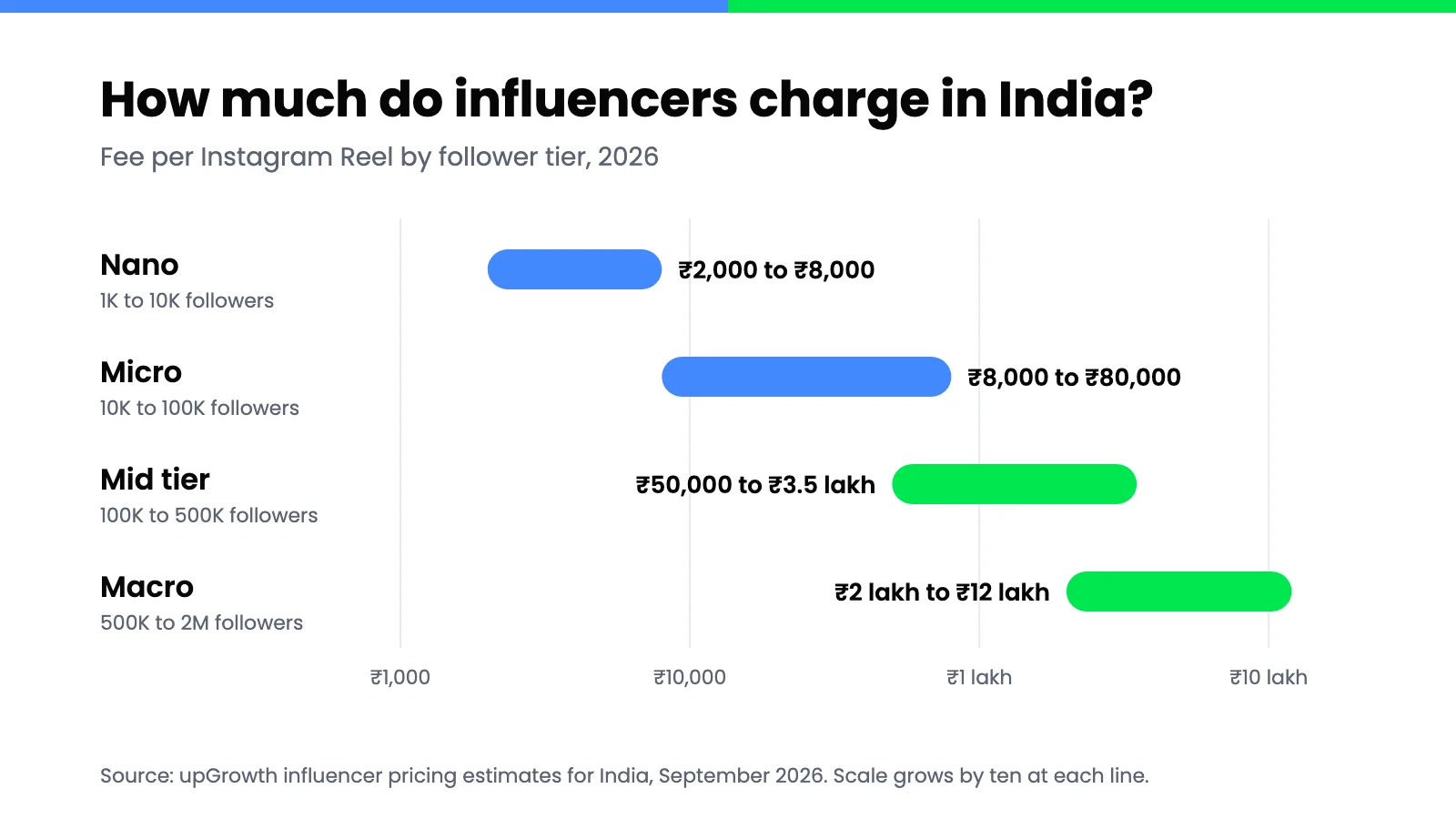
How much do influencers charge in India in 2026?
Indian influencers charge a flat fee per post, and the fee rises with follower count. In 2026 rate cards, a nano creator with 1K to 10K followers asks roughly ₹500 to ₹10,000 for an Instagram Reel, a micro creator with 10K to 100K asks ₹5,000 to ₹80,000, and a mid tier creator with 100K to 500K asks ₹25,000 to ₹3.5 lakh. YouTube videos usually cost more than Reels.
Those ranges come from three Indian rate cards published this year. None of them shares its data or method, and they disagree, so the table shows each one side by side rather than one blended number.
| Tier | Followers | Dazzlerr, Reel (June 2026) | TickTime, Reel (May 2026) | upGrowth, per deliverable (Sept 2026 estimate) |
|---|---|---|---|---|
| Nano | 1K to 10K | ₹500 to ₹5,000 | ₹2,000 to ₹10,000 | ₹2,000 to ₹8,000 |
| Micro | 10K to 100K | ₹5,000 to ₹25,000 | ₹8,000 to ₹75,000 | ₹8,000 to ₹80,000 |
| Mid tier | 100K to 500K | ₹25,000 to ₹1 lakh | ₹50,000 to ₹3.5 lakh | ₹50,000 to ₹3.5 lakh |
| Macro | 500K to 1M (upGrowth: 500K to 2M) | ₹1 lakh to ₹3 lakh | ₹2 lakh to ₹8.5 lakh | ₹2 lakh to ₹12 lakh |
| Mega and celebrity | Above 1M (upGrowth: above 2M) | ₹3 lakh and up | ₹6 lakh to ₹25 lakh and up | ₹8 lakh to ₹1 crore or more per campaign |
This guide is published by Musubi, an Indian marketplace where brands pay creators per 1,000 verified views instead of a fee per post. We do not sell influencer deals, and no rate in this post is ours unless it says so. Every figure links to the page it came from, checked on 17 November 2026.
Why do influencer rate cards in India disagree so much?
Indian rate cards disagree because each one is an estimate with no published sample, and each draws its tiers and formats differently. For the same micro creator Reel, Dazzlerr's top figure is ₹25,000 while upGrowth's is ₹80,000, more than three times higher.
Three things explain most of the gap:
- Different tier lines. Dazzlerr and TickTime start macro at 500K followers and mega at 1M. upGrowth runs macro up to 2M. StarClinch (March 2026) puts everything from 100K to 1M in one macro band.
- Different deliverables. upGrowth prices "per deliverable", assuming one organic Reel with no usage rights. Dazzlerr gives a Reel and a static post separately. A quote that bundles Stories or ad rights will sit above all of them.
- Who wrote it. All five guides used here come from agencies, booking platforms or creator education sites. upGrowth labels its figures "negotiation benchmarks, not fixed prices", and TickTime calls its own "benchmark ranges, not guaranteed prices".
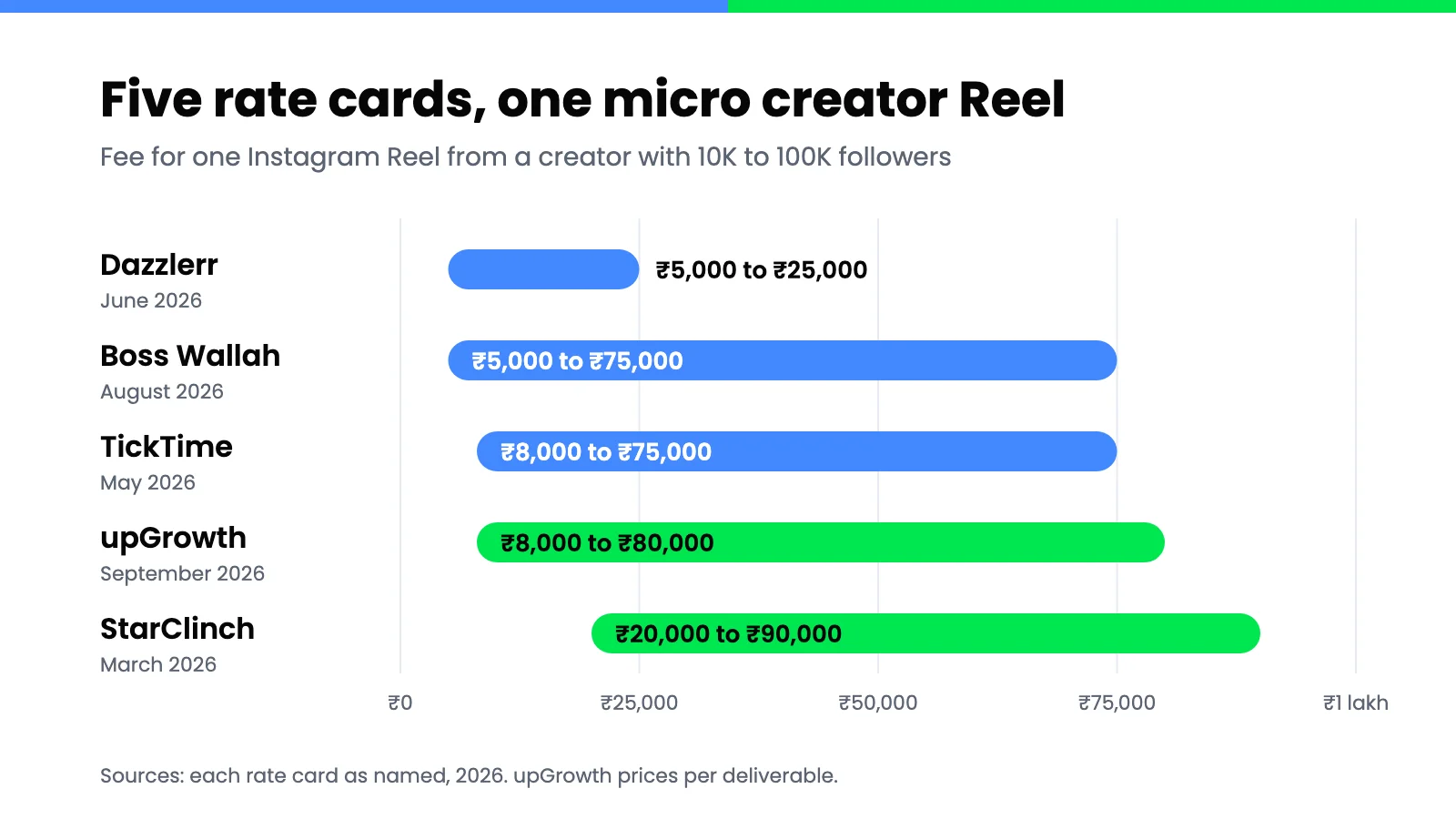 Five rate cards, one micro creator Reel: the top of the range differs by more than three times.
So treat any single table as a starting point for negotiation, not a price. The quote that matters is the one a creator gives you, and the way to test it is in the section on cost per 1,000 views below.
How much do Instagram influencers charge per Reel, Story and post?
On Instagram a Reel costs the most, a static post or carousel less, and a set of Stories the least. Every source here agrees on that order, even where the rupee figures differ.
| Format | Micro, 10K to 100K (Boss Wallah, Aug 2026) | Micro, 10K to 100K (StarClinch, Mar 2026) | Macro, 100K to 1M (StarClinch, Mar 2026) |
|---|---|---|---|
| Reel | ₹5,000 to ₹75,000 | ₹20,000 to ₹90,000 | ₹1 lakh to ₹5 lakh |
| Static post or carousel | ₹3,000 to ₹15,000 | ₹15,000 to ₹60,000 | ₹80,000 to ₹3 lakh |
| Stories | ₹1,500 to ₹8,000 for 3 to 5 | ₹8,000 to ₹30,000 for 5 slides | ₹40,000 to ₹1.5 lakh for 5 slides |
Bundles change the sum. upGrowth estimates that a Reel, Story and feed post combo costs 1.6 to 2 times a single Reel, and a package of three Reels 2.2 to 2.5 times one. StarClinch puts bundle discounts at 20 to 35 percent against buying each piece alone.
How much do YouTubers charge in India?
Indian YouTubers charge more than Instagram creators of a similar size for long videos, and about the same for Shorts. upGrowth estimates that a 60 to 180 second integration inside a video costs 2 to 4 times a Reel, and says Shorts are priced close to Reels.
TickTime gives a dedicated YouTube video by tier:
| Tier | Subscribers | Dedicated video (TickTime, May 2026) |
|---|---|---|
| Nano | 1K to 10K | ₹5,000 to ₹20,000 |
| Micro | 10K to 100K | ₹20,000 to ₹1.2 lakh |
| Mid tier | 100K to 500K | ₹1.5 lakh to ₹5 lakh |
| Macro | 500K to 1M | ₹5 lakh to ₹25 lakh and up |
| Mega | Above 1M | ₹10 lakh to ₹1 crore and up |
Format matters as much as size. StarClinch prices a 60 second integration from a micro channel at ₹15,000 to ₹60,000 and a full dedicated video at ₹30,000 to ₹1.5 lakh. For a 500K subscriber tech or finance channel, upGrowth estimates ₹2.5 lakh to ₹6 lakh for a 60 to 90 second integration and ₹5 lakh to ₹12 lakh for a dedicated review.
Language moves the YouTube price too. upGrowth estimates that regional language channels charge 40 to 60 percent less than Hindi or English channels of the same size.
What makes an influencer charge more?
Followers set the starting band, and six other things move the price inside it. Ask about each one before you compare two quotes, because a quote that includes them is not the same purchase as one that does not.
- Niche. upGrowth estimates beauty and lifestyle creators charge 40 to 80 percent more than fitness and gaming creators, and finance creators 60 to 120 percent more. Its example: a 50K follower beauty creator at ₹25,000 to ₹60,000, against ₹15,000 to ₹35,000 for a fitness or food creator. Boss Wallah puts finance and tech at roughly 2 to 3 times lifestyle or comedy.
- Usage rights. Using the video in your own ads or on your site costs extra. StarClinch adds 20 to 50 percent per month of use beyond the campaign. Our comparison of clipping and influencer marketing lists upGrowth's whitelisting and perpetual use premiums.
- Exclusivity. Keeping the creator away from your competitors raises the fee. upGrowth estimates 30 to 50 percent for 30 days and 80 to 150 percent for 90 days.
- Speed and revisions. StarClinch adds 25 to 40 percent for delivery in under 48 hours, and ₹5,000 to ₹30,000 for each round of changes beyond two.
- Season. Rate cards rise before Diwali. "The 'festive rate card' is real, with rates jumping 15 to 30 percent," Ambarish Sengupta of Hypothesis by OML told Social Samosa in September 2025.
- Middlemen. upGrowth estimates that talent managers add 15 to 25 percent, and agencies charge 15 to 25 percent of creator spend or a fixed fee per campaign.
Tax sits on top of all of this. StarClinch notes 18 percent GST on creator fees and 10 percent TDS withheld by the brand. India's new Income tax Act took effect on 1 April 2026, as upGrowth points out, so confirm the TDS section and threshold with your CA before you pay.
How do you check an influencer quote per 1,000 views?
Divide the fee by the creator's average views and multiply by 1,000. That gives the cost per 1,000 views you are being asked to pay, and it lets you compare a ₹20,000 creator with a ₹60,000 one on the same scale.
Creators are taught the same sum in reverse. Boss Wallah's August 2026 guide tells micro creators to take their average Reel views, divide by 1,000 and multiply by ₹100 to ₹400 depending on niche. So a fair quote, by that rule, works out at ₹100 to ₹400 per 1,000 average views.
For example, say a creator quotes ₹30,000 for one Reel, and their last ten Reels averaged 60,000 views. That is ₹30,000 ÷ 60,000 × 1,000 = ₹500 per 1,000 views, above the top of Boss Wallah's band. It may still be worth it for a finance or tech audience, but it is a reason to ask why or to negotiate. These are picked numbers to show the arithmetic, not a real quote.
Three checks keep the sum honest:
- Ask for views, not followers. Request screenshots of plays and reach for the last ten Reels from the creator's Instagram insights. Followers say nothing about how far the next Reel will travel.
- Use the median, not the best Reel. One viral Reel lifts the average. The middle Reel of ten is a safer guide to what yours will get.
- Remember the views are not promised. The fee is fixed before posting, and a sponsored Reel can do worse than the creator's average. Boss Wallah also tells creators to ask for about 50 percent upfront, so half the money moves before anyone has watched.
How does paying per 1,000 views compare with an influencer fee?
Paying per 1,000 views flips who carries the risk. With an influencer, you fix the fee and hope for the views. With a clipping campaign, many creators post short clips about your brand and you pay a rate only on the views their clips actually get, counted and checked after posting.
On Musubi, brands set their own rate per 1,000 verified views, and the lowest rate accepted is ₹30. A 10 percent platform fee sits on top of the budget, the budget is a hard ceiling, and the smallest campaign is ₹2,000.
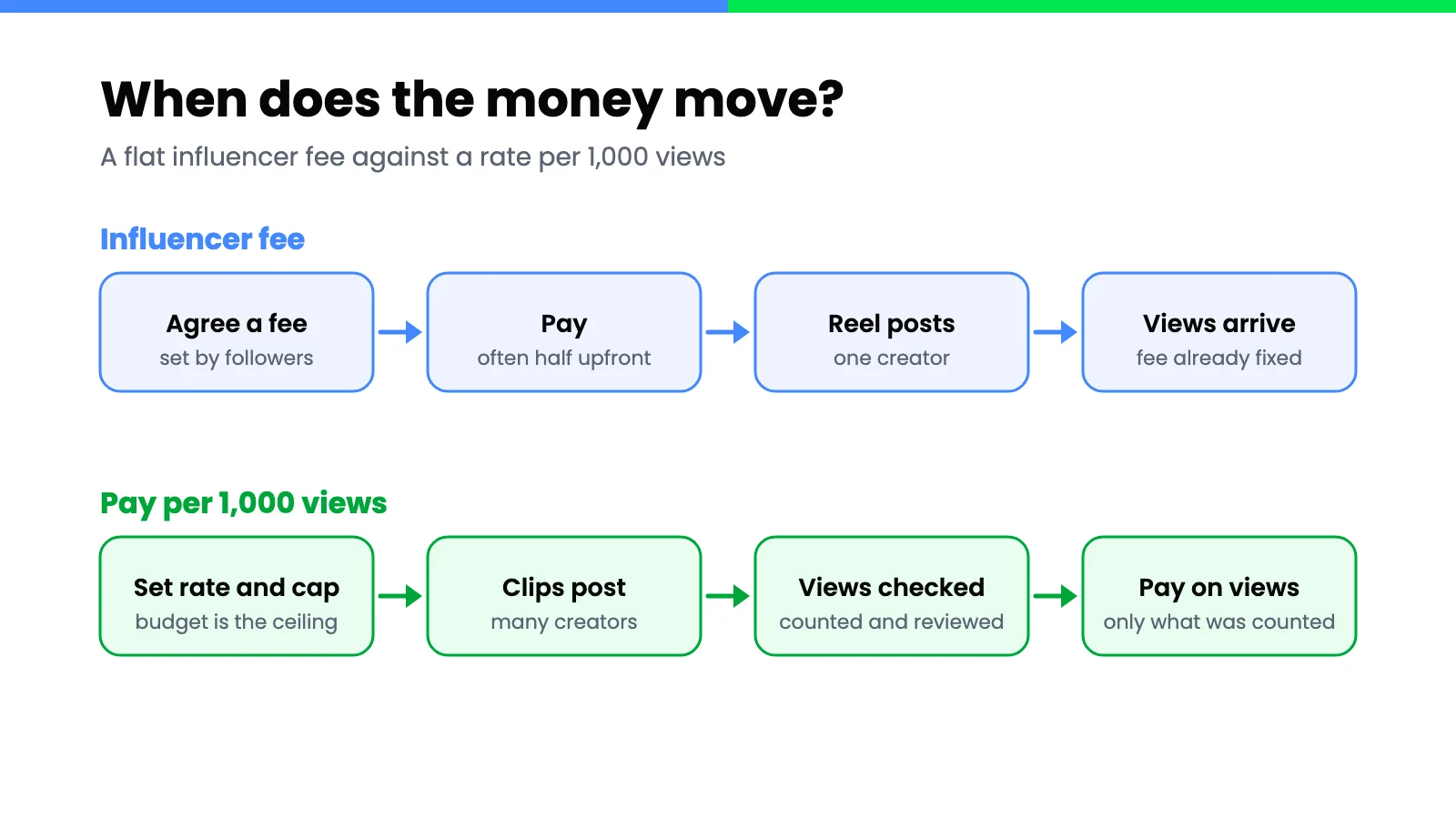 A flat fee is fixed before the views exist; a per view rate is paid only on views that are counted.
| Influencer fee | Pay per 1,000 views (clipping) | |
|---|---|---|
| What sets the price | Follower tier, niche, format, rights | The rate per 1,000 views the brand chooses |
| When the price is fixed | Before posting | Before posting, but paid only on views counted after |
| Typical cost per 1,000 views | ₹100 to ₹400 of expected views, by Boss Wallah's creator rule | From ₹30 of verified views on Musubi, plus the 10 percent fee |
| What a flop costs | The full fee | Little, because few views were earned |
| What you get that the other lacks | One trusted voice and their audience | Many clips and many hooks, at a capped spend |
The two are not the same purchase. An influencer sells a recommendation to people who already follow them, which a stranger's clip cannot. Clipping sells reach you can count. For a worked break even between one Reel and a clipping budget, see clipping vs influencer marketing. For how clipping rates compare with Reels and Shorts ads, see what clipping costs per 1,000 views.
How should an Indian brand budget for influencers in 2026?
Start from a share of your digital budget, split it across tiers, and keep a test budget for pay per view. In Social Samosa's September 2025 report, Ambarish Sengupta said brands were putting 12 to 20 percent of their whole digital budget into creators.
For the split, Priya Vivek of Qoruz suggested in the same piece about 60 percent on regional micro and nano creators, 30 percent on metro mid and macro creators, and 10 percent on marquee names. That mix leans on smaller creators, whose fees are lower. Gautam Madhavan of Xley.ai said in the same piece that regional content drives about 30 percent higher engagement than English content.
The market keeps growing, which pushes rates up. EY and Big Bang Social's report, covered by Social Samosa in April 2024, projected India's influencer marketing industry at ₹2,344 crore in 2024 and ₹3,375 crore by 2026.
A simple plan for a first quarter:
- Pick two or three micro creators in your niche, check each quote per 1,000 views, and agree usage rights in writing.
- Avoid the festive weeks for a first test if you can, since rates rise then.
- Run a small per view campaign beside them. It shows which hooks travel before you brief the next creator. The guide to running a clipping campaign in India covers the brief, rate and cap, and the Musubi brands page shows the most views a budget can pay for before you fund it.
Questions brands ask
How much does a micro influencer charge in India?
A micro influencer, with 10K to 100K followers, charges roughly ₹5,000 to ₹80,000 for one Instagram Reel in 2026, by rate cards from Dazzlerr, Boss Wallah, TickTime and upGrowth. StarClinch puts the range higher, at ₹20,000 to ₹90,000. Niche matters most inside the band: finance and tech creators charge well above lifestyle or comedy creators with the same following.
Do influencers charge GST in India?
Creators registered for GST add 18 percent to their fee, as StarClinch's 2026 pricing guide notes, and brands usually withhold TDS on the payment too. India's new Income tax Act took effect on 1 April 2026, so the TDS section and threshold should be confirmed with a chartered accountant before paying. Ask every creator whether their quote includes GST before comparing quotes.
Do influencers in India ask for payment in advance?
Many do. Boss Wallah's August 2026 guide tells micro creators to ask for about 50 percent upfront, especially from new or smaller brands, with the rest after posting. That means half the fee is paid before the post exists and before any views are counted. Agree the split, the posting date and what happens if the post is late in writing.
How much do celebrities charge per post in India?
Celebrity fees sit far above creator rate cards. upGrowth estimates that a Bollywood A list actor or top cricketer charges ₹25 lakh to ₹3 crore per post or integration, in its September 2026 estimates. Creators above 1M or 2M followers who are not film or sports stars are put at ₹3 lakh to ₹1 crore or more, depending on the rate card.
Is a YouTube Short cheaper than a YouTube video?
Yes. A YouTube Short is priced close to an Instagram Reel, while a full integration or dedicated video costs more. StarClinch puts a micro channel's Short at ₹10,000 to ₹40,000 and its dedicated video at ₹30,000 to ₹1.5 lakh. upGrowth estimates that a 60 to 180 second integration costs 2 to 4 times a Reel.
Plan a campaign
Set a rate, a cap and a budget, and see what it buys before you pay.
Plan a campaign