Is clipping legal in India? Copyright, fair dealing and whose videos you can clip
Clipping is legal in India when you own the footage or its owner has given you permission, as a brand does when it hands you footage for a paid campaign. Clipping someone else's video without permission is usually copyright infringement under the Copyright Act, 1957, and no clip length, credit line or disclaimer makes it safe.
Is clipping legal in India?
Clipping is legal in India when you have the right to use the footage: your own video, or someone else's video with the owner's permission, such as footage a brand gives you for a paid campaign. Clipping another creator's video without permission is usually copyright infringement, because India's fair dealing exception covers only a few narrow purposes.
That gives three cases to keep in your head:
| Your footage | Is the clip legal? | Why |
|---|---|---|
| Your own video | Yes | You own the copyright |
| Someone else's video, with their permission | Yes, within what they allowed | The owner licensed the use to you |
| Someone else's video, no permission | Usually not | Infringement, unless fair dealing applies, and a paid clip page rarely fits it |
Musubi publishes this guide. Musubi is an Indian marketplace where brands pay creators per 1,000 verified views on Instagram Reels and YouTube Shorts, so it has a stake in the answer. Every legal and platform claim below links to the statute, the court judgment or the platform's own help page, read on 21 October 2026.
This is general information, not legal advice. Copyright cases turn on their facts. If a notice or a lawsuit lands on you, speak to a lawyer.
What does Indian copyright law say about clipping?
Indian copyright law treats cutting and reposting a video as copying it, which only the owner may do or allow. Under section 14 of the Copyright Act, 1957, the owner of a film has the exclusive right "to make a copy of the film" and "to communicate the film to the public", and that right covers the whole work "or any substantial part thereof". Section 51 says copyright is infringed when anyone does one of those acts "without a licence granted by the owner".
India has no fair use. It has fair dealing, under section 52(1)(a), which allows a fair dealing with a work only for three purposes:
- "private or personal use, including research";
- "criticism or review, whether of that work or of any other work";
- "the reporting of current events and current affairs, including the reporting of a lecture delivered in public".
The list is closed. Fair use in the United States weighs open factors, so a US article saying "transformative clips are fine" does not describe Indian law. An entertainment clip page that reposts the funniest 30 seconds of a podcast is not private use, is not a review and is not news reporting, so it sits outside all three purposes. A clip that genuinely reviews or criticises the original can fit the second purpose, but the commentary has to be the point of the clip.
Is there a safe clip length, like 10 or 30 seconds?
No. No Indian law or court sets a number of seconds that makes a clip safe, and the Delhi High Court has refused to apply one. The "7 second rule", "10 second rule" and "30 second rule" are internet myths. Section 52 says nothing about length at all.
| The myth | What the court or platform actually said | Source |
|---|---|---|
| "Under 30 seconds is always fine" | "such a 30 seconds/7 minutes cap cannot apply across the Board" | ESPN Star Sports v Global Broadcast News, Delhi High Court division bench, 2008 |
| "Short clips of 10 to 40 seconds are fine" | The channel argued its clips ran 10 to 40 seconds; the court held that fair dealing "cannot be reduced just a quantitative test" and that "even small extracts, which are taken, on regular basis may point to unfair use" | Super Cassettes v Hamar Television, Delhi High Court, 2010 |
| "A few seconds will not get claimed" | A Content ID claim "will keep you from monetizing the video, even if you only use a few seconds" | YouTube Help, fair use |
| "A small piece is always fair" | "if what's borrowed is considered the 'heart' of the work, sometimes even a small sampling may not be considered fair use" | YouTube Help, fair use |
The Hamar judgment sums up the Indian test: fair dealing is "a question of fact, degree, and at the end of the day overall impression carried by the court". Courts look at how much you took, which part, why, and whether your clip replaces the original. For a clipper, that cuts the wrong way. A clip is built to be the best few seconds of a video, and a clip page posts them regularly, which is exactly the pattern Hamar warned about.
Whose videos can you clip, and whose can you not?
You can clip a video when you own it or its owner has said yes, in terms that cover what you are doing. Everything else is someone else's property, however easy it is to download.
| Footage | Can you clip it? | What decides it |
|---|---|---|
| Your own videos | Yes | You own them, unless they contain someone else's music or footage |
| A brand's footage on a campaign brief | Yes, for that campaign | The brand owns or licenses the footage and gives it to you for the platforms the brief names |
| A podcaster or streamer who hired you or agreed in writing | Yes, within the agreement | Their written permission; music or video inside their stream may belong to someone else |
| A random creator's YouTube video or Reel | Not without permission | Their copyright under section 14 |
| Films, web series and film songs | Not without a licence | Studios and music labels own them and enforce them |
| Cricket and other sports broadcasts | Not without a licence | Broadcasters hold the rights; ESPN v Global Broadcast News was about cricket footage |
| News channel footage | Not without permission | The channel's copyright; reporting current events is a defence for news reporting, not for a clip page |
| Recordings of court hearings | Not without the court's permission | A Supreme Court interim order of 24 July 2026 |
Court hearing clips need permission now. In an interim order of 24 July 2026 in Harshita Grover v Union of India, the Supreme Court barred extracting, posting, reposting, modifying or monetising audio and video recordings of court proceedings on social media without prior permission, according to SCC Online's report of the order. The order does not affect reporting of court proceedings by recognised news outlets.
Permission that counts is specific. It names the footage, the platforms, whether you may earn from the clip and how long the clip may stay up. A comment saying "sure, go ahead" under a video is weak evidence; a written brief or message you can screenshot is better. Keep it for as long as the clip is live.
Does giving credit or adding commentary make a clip legal?
Giving credit does not make a clip legal. Tagging the creator, writing "all rights go to the author" or "no copyright intended" changes nothing about who owns the footage. YouTube's fair use page says "There aren't any magic words", and that phrases like "I do not own" do not "mean you have the copyright owner's permission".
Instagram's copyright help goes further. It says you can infringe someone's copyright even if you "Gave credit to the copyright owner", "Included a disclaimer", "Didn't intend to profit from it", "Modified the work or added your own original material to it" or "Saw that others posted the same content as well". Its advice is to post content you created yourself, and to get "written permission from the author of the work" before posting anything else.
Commentary is different, but only real commentary. A review or critique can fall under section 52(1)(a)(ii), and the Hamar judgment notes that "short extracts followed by long comments may be fair" while "long extracts followed by short comments may in certain circumstances be unfair". A caption, a subtitle or an emoji reaction over someone's clip is not a review.
What happens if you clip without permission?
Most of the time the platform acts first, and the account you earn from takes the hit. The consequences climb in rough order:
| Step | Who acts | What it costs you | Rule |
|---|---|---|---|
| A claim or a muted, blocked or demonetised clip | The platform, often automatically | That clip's reach or earnings | YouTube Content ID; Instagram reports |
| Removal and a copyright strike | The platform, after the owner's removal request | The clip, plus a strike on your channel | YouTube copyright strikes; Instagram repeat infringer policy |
| Account or channel loss | The platform | Every clip and every follower on that handle | Three YouTube strikes in 90 days; repeat infringement on Instagram |
| A legal notice or a civil suit | The owner | An injunction, damages and accounts | Copyright Act, section 55 |
| A criminal complaint | The owner, through the police or a court | Imprisonment and a fine for knowing infringement | Copyright Act, section 63 |
Knowing infringement is a crime in India, which many US pages forget to say. Section 63 punishes anyone who "knowingly infringes" with imprisonment of six months to three years and a fine of ₹50,000 to ₹2 lakh, and lets a court go lower when the infringement "has not been made for gain in the course of trade or business". A paid clip page is a business. Most clippers who get into trouble meet the first two rows, not the last two, but the law reaches all the way down the table.
What do a copyright claim and a strike do on YouTube and Instagram?
On YouTube, a claim and a strike are different things. A Content ID claim comes from YouTube's automatic match, and depending on the owner's settings it blocks the video, monetises it for the owner or tracks its views. YouTube says you will "not receive a copyright strike for videos that contain active claims", and that claims "usually don't impact your channel". One exception matters for clippers: "Shorts longer than one minute that have an active copyright claim, regardless of the policy, will be blocked", according to YouTube's page on claims.
A strike means your content "was removed due to a legal copyright removal request", per YouTube's strike rules:
- A strike expires in 90 days if you complete Copyright School and have fewer than three strikes.
- "Channels that get 3 copyright strikes in 90 days are subject to termination", and you cannot create new channels.
- Deleting the video usually does not remove the strike.
- Disputing a claim "without a valid reason" lets the owner file a removal request, which can turn a claim into a strike.
YouTube also has a separate rule that hits clip channels without any claim at all. Its reused content policy can remove monetisation "from your entire channel" when it repurposes other people's videos without "significant original commentary, substantive modifications", and the policy "applies even if you have permission from the original creator". Permission makes a clip legal; it does not by itself make a channel of clips eligible for YouTube ad revenue.
YouTube's own remix tools are the one built in exception. The Shorts remix feature lets you sample a 1 to 5 second cut of an eligible music video, credits the original, and deletes your remix if the owner deletes the video or restricts remixing. A clip you cut elsewhere and upload gets no such cover.
On Instagram, content reported for infringement is removed, and you can appeal. Instagram's help says that if you repeatedly post infringing content, "your account may be disabled or your Page removed under Instagram's repeat infringer policy". Its Terms of Use make you promise you "own or have obtained all necessary rights to the content you post".
Is paid campaign clipping legal?
Paid campaign clipping is legal when the brand or creator paying you owns the footage and lets you clip it for the campaign. That permission is the whole difference between a campaign clip and a reposted video: the same cut, from the same video, is licensed in one case and infringing in the other.
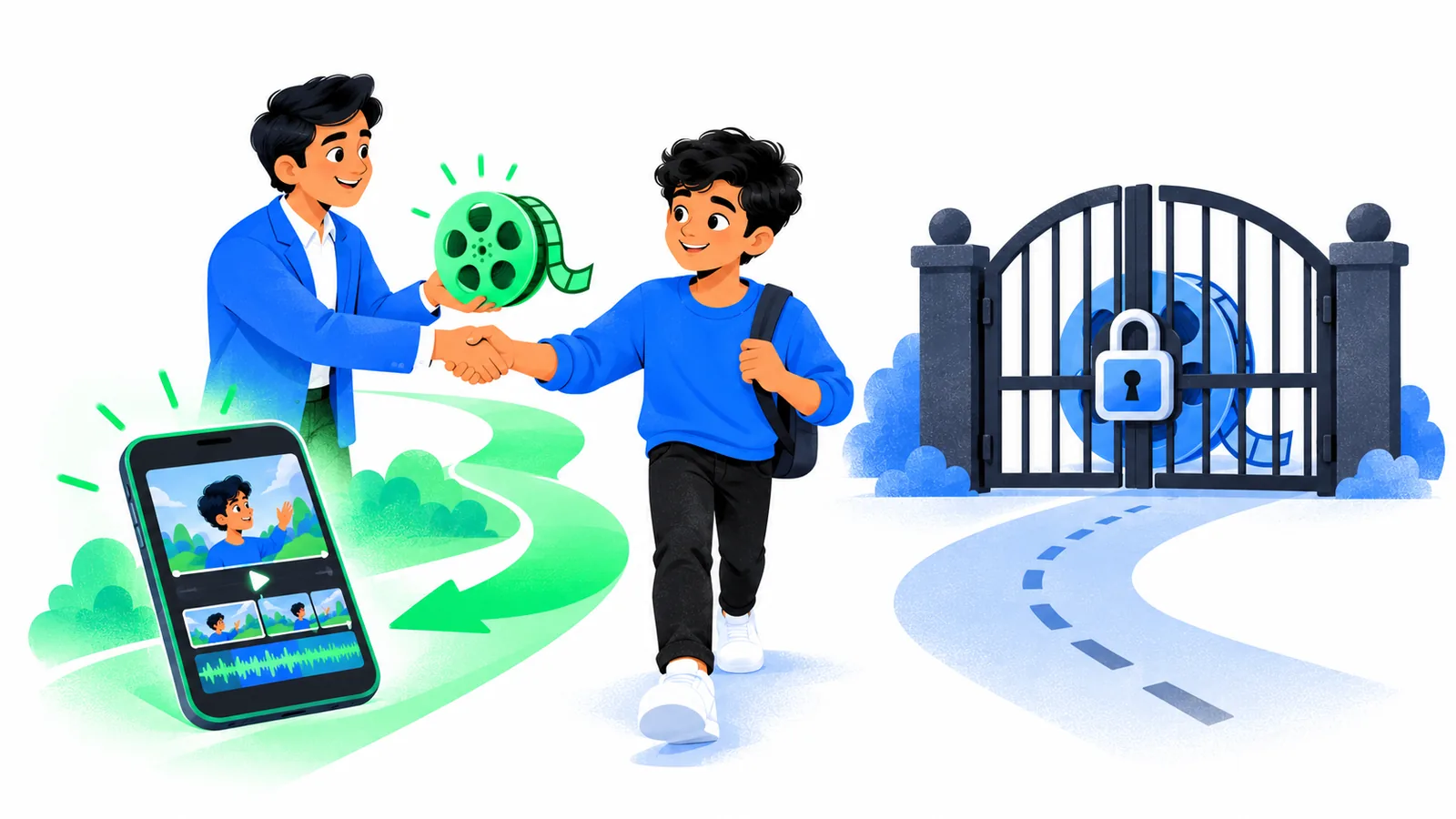 Campaign footage comes with the owner's permission; someone else's video stays locked until its owner says yes.
On Musubi, a brand provides the footage or a brief for its campaign, and you post the clip as an Instagram Reel or YouTube Short on your own account. Views are read from the post, the clip is reviewed, and once it is approved its earnings move to your wallet. A withdrawal goes to your UPI ID within 48 hours of the request, with a ₹10 minimum and a 5 percent withdrawal fee. Joining is free, there is no follower minimum, and you must be 18 or over and based in India. The Musubi terms also ask creators to "Not submit clips that violate copyright, contain illegal content, or violate platform guidelines of Instagram/YouTube", and list "content that infringes copyright" among the things that lead to suspension and forfeiture of pending earnings.
Two traps catch campaign clippers:
- Music you add yourself. A brand's licence covers the brand's video, not a film song or trending track you lay over it. Use the audio in the footage, or audio the brief allows.
- Footage from outside the brief. Mixing in a movie scene, a cricket highlight or another creator's reel brings back every risk in the table above, even inside a paid campaign.
For how campaigns pay and how to pick one, see how to make money clipping in India and the comparison of clipping platforms in India. If an offer asks you to pay before you earn, read how to tell real clipping from a scam.
How do you clip safely in India?
The safest way to clip in India is to use only footage whose owner has given it to you, for the platforms and use they named. Run this check before every clip:
- Whose footage is it? Yours, or a named owner who said yes. If you cannot name the owner, do not post it.
- Is the permission in writing? A campaign brief, a contract or a message you can screenshot. Save it.
- Does it cover this platform and this use? Reels, Shorts or both, and whether you may earn from it.
- Is the audio covered too? Keep the original audio or use what the brief allows.
- Is anything else in the frame? Film scenes, sports broadcasts, news footage and court recordings need their own permission.
- If you get a claim, check before you dispute. Dispute only when you hold the permission, and attach it.
- Know your handle's record. On YouTube, three strikes in 90 days can end the channel, so one risky clip is never worth it.
Clipping is a real job in India, and its legal footing is simple: you are paid to clip footage that someone who owns it wants spread.
Questions creators ask
Is clipping legal on YouTube?
Clipping is legal on YouTube when you own the footage or have the owner's permission. Without it, the owner can claim your clip through Content ID or file a removal request that puts a copyright strike on your channel. Separately, YouTube's reused content policy can remove monetisation from a whole channel of clips that add no significant original commentary, even with permission.
Can you go to jail for clipping in India?
It is possible but rare. Section 63 of the Copyright Act, 1957 makes knowing infringement an offence, with imprisonment of six months to three years and a fine of ₹50,000 to ₹2 lakh, and a court may go lower when it was not for gain in trade or business. Most clippers who infringe face takedowns, strikes or a civil claim first.
Is Whop clipping legal in India?
Whop clipping is legal for a creator in India when the campaign owner supplies the footage or licenses it to clippers, which is how a campaign brief is meant to work. Read each brief for the footage, platforms and rules it allows. Clipping a video that is not part of the brief is no more legal on Whop than anywhere else.
Can I add a Bollywood song or trending audio to a campaign clip?
Only if the brief allows it or you hold the rights. A song is a separate sound recording with its own owner under the Copyright Act, and a brand's permission covers the brand's footage, not music you add. A popular song can draw a YouTube Content ID claim even when only a few seconds are used. Keep the original audio or use what the brief names.
Is it legal to clip podcasts and streamers in India?
It is legal when the podcaster or streamer gives you permission, ideally in writing, that names the platforms and whether you may earn from the clips. Without permission, clipping their episodes is copyright infringement. Watch for music, film scenes or other people's videos inside the stream, which their permission may not cover.
Does deleting a clip remove a YouTube copyright strike?
Usually not. YouTube says deleting a video does not resolve a copyright strike, except for a scheduled removal request, which gives you 7 days to take the video down and avoid the strike. A strike expires after 90 days if you complete Copyright School and have fewer than three.
Start earning
Pick a live campaign, post your clip, and get paid for the views it gets.
Start earning