What is clipping? How it works and how clippers get paid
Clipping is cutting short clips out of long videos, such as podcasts, streams or a brand's own footage, and posting them on your own account for pay. Clippers usually earn a rate per 1,000 views, up to a cap per clip, from a budget the brand funds. In India it runs on Reels and Shorts and pays to UPI.
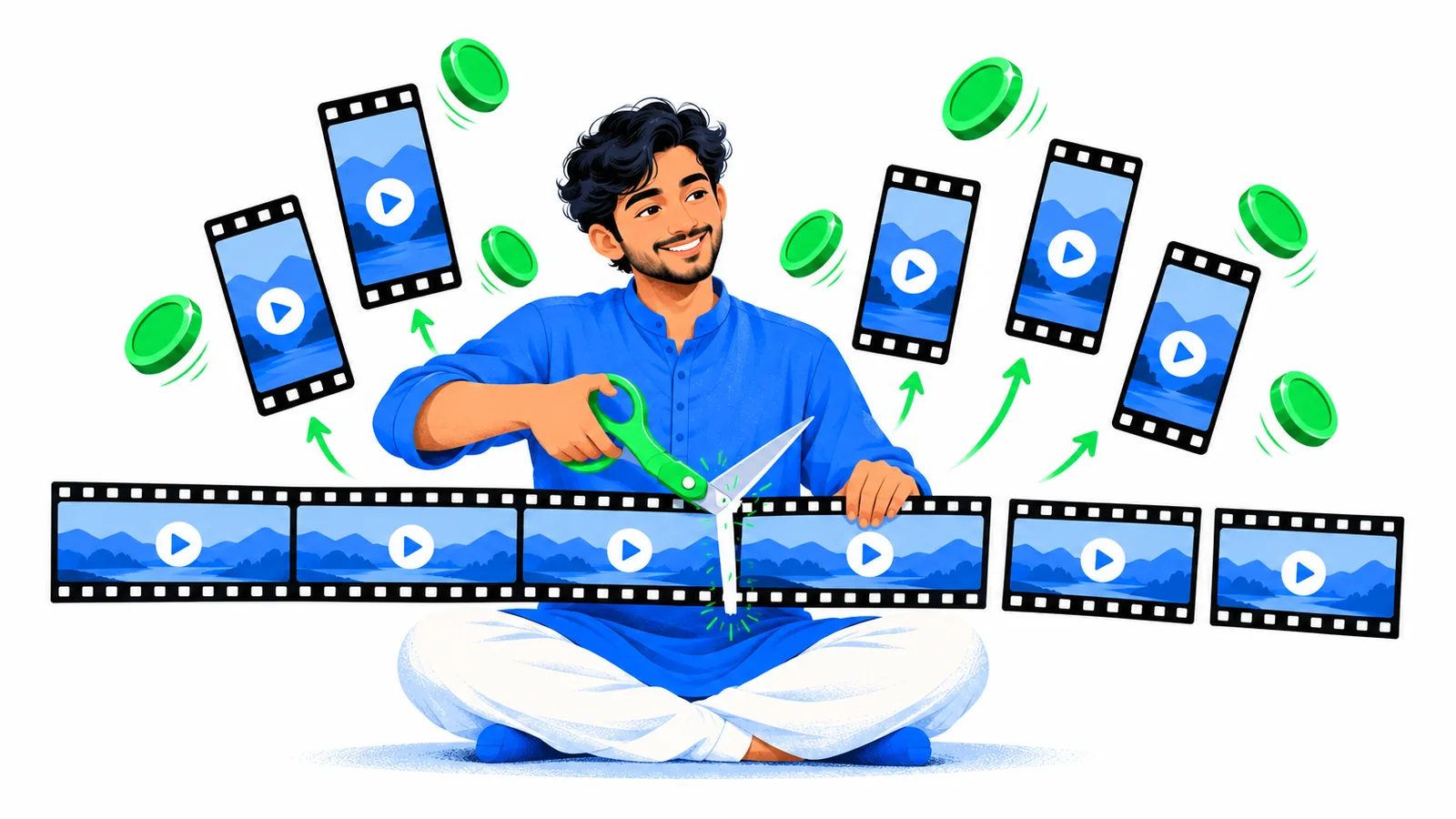
What is clipping?
Clipping is the work of turning long videos into short ones and posting them to reach more people, usually for pay. The long video can be a podcast, a livestream, an interview, a film or a brand's own product footage. The short version is a vertical clip with captions and a hook in its first seconds.
- A clipper is the person who finds the best moments, cuts them and posts them on their own account.
- A clipping campaign is the paid version. A brand or creator supplies the footage and a brief, sets what it pays per 1,000 views and the most one clip can earn, and pays clippers out of a budget it has funded.
- Content clipping is another name for the same work.
This guide is written by Musubi, an Indian marketplace where brands pay creators per 1,000 verified views on Instagram Reels and YouTube Shorts (about Musubi). Musubi is one of several platforms that pay for clipping, so weigh what we say about it with that in mind.
Clipping in social media is not coupon, audio or press clipping
Clipping in social media means cutting long videos into short paid clips, and it has nothing to do with the other meanings of the word, which search results often mix in:
| If you searched for | What it means |
|---|---|
| Coupon clipping | Cutting out or saving discount coupons |
| Press or newspaper clippings | Articles cut out of a paper and kept for reference |
| Audio clipping | Distortion when an amplifier is pushed past what it can deliver |
| Clipping mask or clipping path | An image editing tool that keeps only what sits inside a shape |
| Clipping in computer graphics | Drawing only what falls inside a chosen region of the screen |
| Clipping in word formation | Shortening a word, as "exam" from "examination" |
| Clipper circuit | An electronics circuit that stops a signal going past a set voltage |
| Clipping in social media | Cutting long videos into short clips and posting them, often paid per 1,000 views |
The rest of this guide is about the last row.
Where did clipping come from?
Clipping began with streamers and grew into a marketplace. In the late 2010s, streamers such as Ninja asked fans to make highlight clips of their streams, and short video apps then made clips one of the main ways people watch online, according to Wikipedia's history of clipping (last edited 13 October 2026).
Money followed. Large creators began paying other people to cut and share their clips, mostly through private Discord servers that you could join only if you knew someone, Digiday reported on 26 May 2025. In March 2025, Whop opened a dedicated clipping platform to the public with the same rules: bounties, view checks and a maximum payout per clip. Today the model runs on open marketplaces such as Content Rewards, which uses Whop for payments and withdrawals, according to its creator terms.
By 2026 clipping was mainstream news. On 12 May 2026, NPR reported that marketplaces "like Content Rewards and Vyro" were fuelling demand, with live campaigns paying $1 per 1,000 views for clips of baseball games and $25 per 1,000 views for clips about an AI startup's product.
How does a clipping campaign work?
A clipping campaign runs in six steps, and the order is much the same on every platform, from Whop's Content Rewards guide to Musubi:
- The brand writes a brief and funds a budget. The brief holds the footage, the rules, the rate per 1,000 views and the cap per clip.
- You pick a campaign and cut a clip from the footage it supplies. A free phone editor is enough; here are the best free apps for clipping videos.
- You post the clip on your own account, not the brand's, and submit the post link.
- Views are counted from the post itself, not typed in by you.
- The clip is reviewed against the brief. A clip that breaks the rules is rejected and earns nothing.
- You are paid from the budget for the views, up to the cap, and withdraw the money.
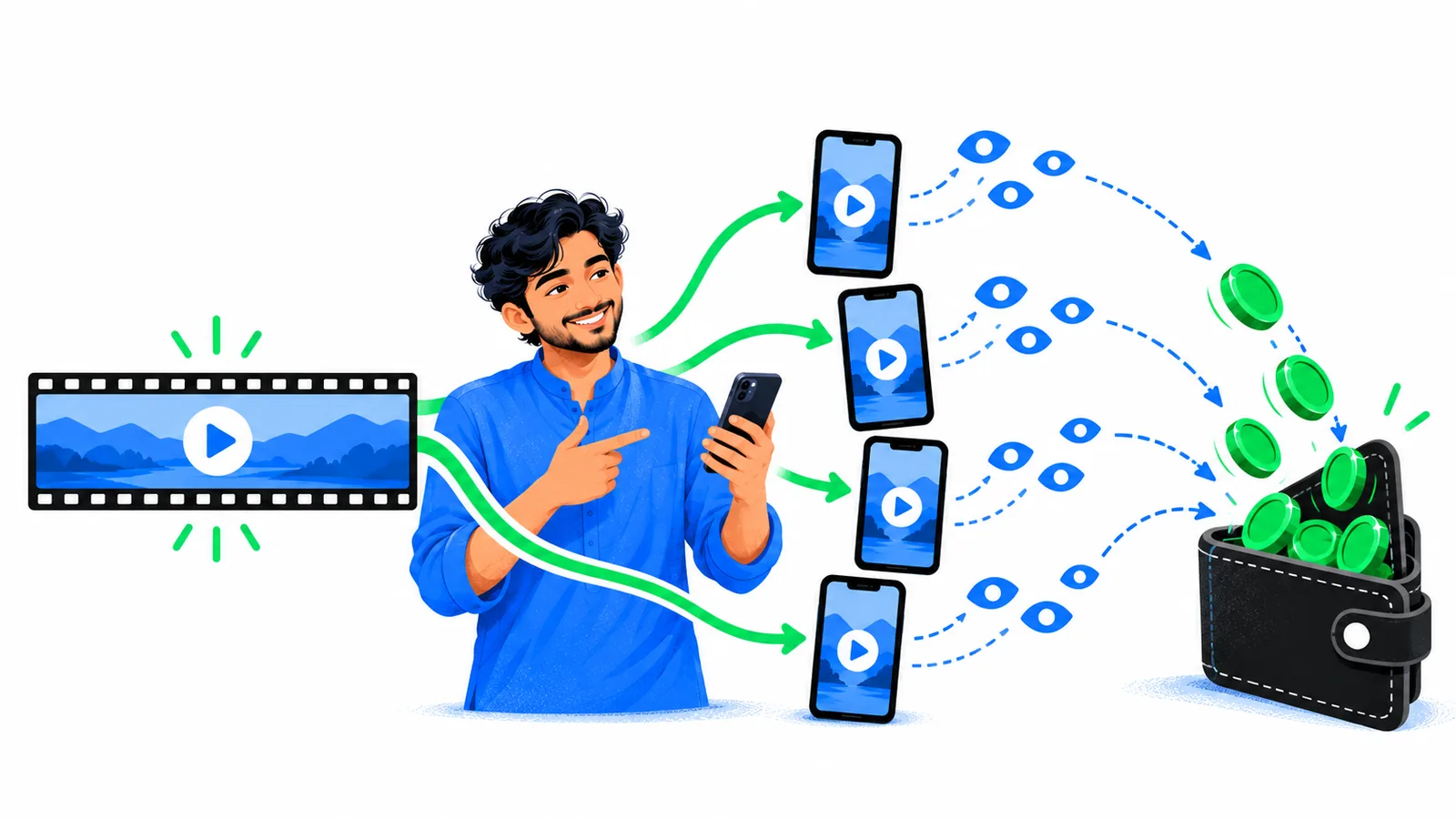 One long video becomes many short clips, and the approved views on each clip are what turn into pay.
Two limits shape every payout. The cap per clip stops one viral clip from eating the budget: in Whop's guide, a $3,000 maximum at $3 per 1,000 views stops a video earning at 1 million views. The budget is the other: when the brand's money runs out, the campaign stops paying.
How do clippers get paid?
Clippers are mostly paid a rate per 1,000 views, up to a cap per clip, but that is one of four models. Content Rewards' creator terms, last updated 4 October 2026, define all four:
| Model | How it pays | For example |
|---|---|---|
| Rate per 1,000 views (CPM) | Each approved clip earns its views ÷ 1,000 × the rate, up to a cap per clip | 40,000 views at $1 per 1,000 views earns $40 |
| Pool | A fixed pot is split among clippers in proportion to their counted views when the pool ends | If your clips hold 10 percent of the counted views in a $1,000 pot, your share is $100 before fees |
| Flat fee per post | A set amount for each approved clip, whatever its views | Paid once, at approval |
| Retainer | A fixed amount for each agreed cycle of work | Paid at the end of each cycle |
The examples are ours, worked from each model's rule. Some briefs add two extras. A minimum payout means a clip must earn a set amount before it counts: in Whop's guide, a $3 rate with a $6 minimum means only clips with at least 2,000 views reach review. A flat fee bonus adds a fixed sum on top of the view rate, so $3 per 1,000 views plus a $10 bonus pays $16 on 2,000 views.
Platforms take a cut: Content Rewards charges creators a flat 10 percent on every CPM and pool payout.
How much do clippers get paid per 1,000 views?
Global campaigns typically pay between $1 and $5 per 1,000 views, with payments capped, according to Digiday in May 2025, and Wikipedia notes some pay as little as $0.20. NPR's live examples in May 2026 ran from 50 cents to $25 per 1,000 views. At the European Central Bank's reference rates for 23 October 2026, $1 was about ₹94.94, so $1 to $5 is roughly ₹95 to ₹475 per 1,000 views.
A dollar rate is no guide to a rupee one. Each brief is priced for the audience its brand wants, and dollar earnings pass through platform fees and currency conversion before they reach an Indian bank. Treat income headlines with the same care: one clipper Digiday interviewed said only that he "would not be surprised" if some made $15,000 to $20,000 a month. That is a guess, not a payout record.
What is clipping in India? Rupees, UPI and Reels
Clipping in India works the same way, but it runs on Instagram Reels and YouTube Shorts, pays in rupees, and on Indian platforms reaches your UPI ID. TikTok is not part of it: the government blocked TikTok and 58 other apps on 29 June 2020, as the Press Information Bureau announced.
Rupee rates are set on each brief. As of 25 October 2026, INDclipping's home page advertises ₹30 to ₹100 per 1,000 views. On Musubi the brand sets the rate, and the lowest rate Musubi accepts is ₹30 per 1,000 views. That is a floor, not a typical rate. Our comparison of clipping platforms in India puts each platform's rate, minimum and fee side by side.
On Musubi, as Musubi's terms and about page set out, a clip becomes money like this:
- Joining is free, there is no follower minimum, and you must be 18 or over and based in India.
- You verify your Instagram or YouTube handle once, and views are read from your post on a schedule, never self reported.
- Every clip is reviewed before it is paid, and approved earnings move to your Musubi wallet.
- A withdrawal reaches your UPI ID within 48 hours of the request. The minimum is ₹10, and a 5 percent fee comes off each withdrawal.
For example, a clip with 50,000 approved views on a brief paying the ₹30 floor earns ₹1,500 before the cap (50,000 ÷ 1,000 × ₹30). Withdraw it and the 5 percent fee is ₹75, so ₹1,425 reaches your UPI ID.
Global platforms take Indian clippers too, with more steps. Whop asks creators outside the US for KYC and a bank account in their own country's currency, and its payout pages do not list UPI; our guide to Whop clipping in India walks through that route. For the whole path from first clip to payout, read how to make money clipping in India.
Who pays for clipping, and why?
Clipping is paid for by anyone who owns long videos and wants more people to see them. On Whop's platform in 2025, the most common buyers were large creators growing their audience, then rights holders such as studios and musicians, then apps, Digiday reported. In India, INDclipping's home page pitches campaigns to D2C brands, apps, YouTubers and music artists.
Brands pay for clipping for three reasons:
- They pay for views, not posts. A clip that flops costs little, and the cap and the budget set the most a campaign can cost. On Musubi the budget is a hard ceiling and a 10 percent platform fee sits on top, shown before the brand pays.
- They get many versions. Many clippers cut the same footage in different ways, and the view counts show which hooks work.
- Clips look like posts, not ads. They go out on real accounts, which is also why a paid clip should carry the paid label the brief and the law ask for.
If you are a brand, start with what clipping costs per 1,000 views and how to run a clipping campaign in India.
Clipping vs UGC
Clipping and UGC differ in what you make. Clipping cuts footage that already exists. UGC, short for user generated content, is original video you film for the brand. On Musubi both are campaign types, and both pay per 1,000 verified views. Whop's guide sets them side by side too, and notes that "UGC content typically pays higher rates than clipping"; filming something new takes more work. Our guide to UGC vs clipping compares the two in rupees.
Is clipping real, and is it legal?
Clipping is real: brands pay a written rate per 1,000 views out of a budget they fund first. What is fake is any "clipping job" that asks you to pay before you earn or promises a fixed daily income. Our guide on whether clipping is real or fake lists the red flags.
Clipping is legal when you have permission to use the footage, such as a brand's own footage supplied under a campaign brief. Reposting other people's videos without permission can infringe copyright, and YouTube's reused content policy can remove monetisation from a whole channel built on them. Read is clipping legal in India before you clip anything a brief did not give you. This is general information, not legal advice.
Questions creators ask
Do you need followers to start clipping?
No. Clipping pays for the views a clip gets, not for the size of the account that posts it, so a small account that performs well earns the same rate per 1,000 views as a large one. Musubi has no follower minimum. You need one Instagram account for Reels or one YouTube channel for Shorts, verified once, and a clip cut from the campaign's own footage.
Can you do clipping in India without TikTok?
Yes. TikTok has been blocked in India since 29 June 2020, so Indian clipping campaigns run on Instagram Reels and YouTube Shorts instead. Musubi pays only for Reels and Shorts. Global platforms such as Content Rewards also accept TikTok and X, so read the platform list on any global brief before you cut a clip for it.
How much can a beginner earn from clipping?
There is no fixed figure, because pay depends on the rate on each brief and the approved views your clips get. At ₹30 per 1,000 views, the lowest rate Musubi accepts, 10,000 approved views earn ₹300 and 1,00,000 earn ₹3,000, before the per clip cap and the 5 percent withdrawal fee. A clip that gets few views earns little, whatever the rate.
Is clipping a full time job?
Clipping is campaign work paid per approved view, not a salaried job. Some clippers say they earn a living from it: one 19 year old told NPR in May 2026 that he makes around $4,000 a month, a figure he reported himself. Most people start with it as side income. Treat any listing that promises a fixed monthly salary for clipping with care.
What skills does a clipper need?
A clipper needs to spot the strongest moment in a long video, cut it into a vertical clip, add captions, and open with a hook in the first seconds. Reading the brief matters as much, because a clip that breaks its rules is rejected. A phone and a free editing app are enough to start, and the craft improves with every clip you post.
What is a clipping agency?
A clipping agency runs clipping for a client: it takes the footage, recruits clippers from its own network, checks their clips and pays them, and charges the client for the service. TheWrap reported in March 2026 that a subscription to the US agency Clipping cost $2,500 to $10,000 a month. On a marketplace such as Musubi, the brand sets its own rate, cap and budget instead.
Start earning
Pick a live campaign, post your clip, and get paid for the views it gets.
Start earning